10-Minute Blackjack Practice Plan
Basic strategy is easier to learn in short, focused drills than in long random sessions. Ten minutes is enough to play several dozen decisions, review mistakes while they are fresh, and stop before fatigue turns practice into guessing. This plan uses the trainer's drill modes to build accuracy in layers.
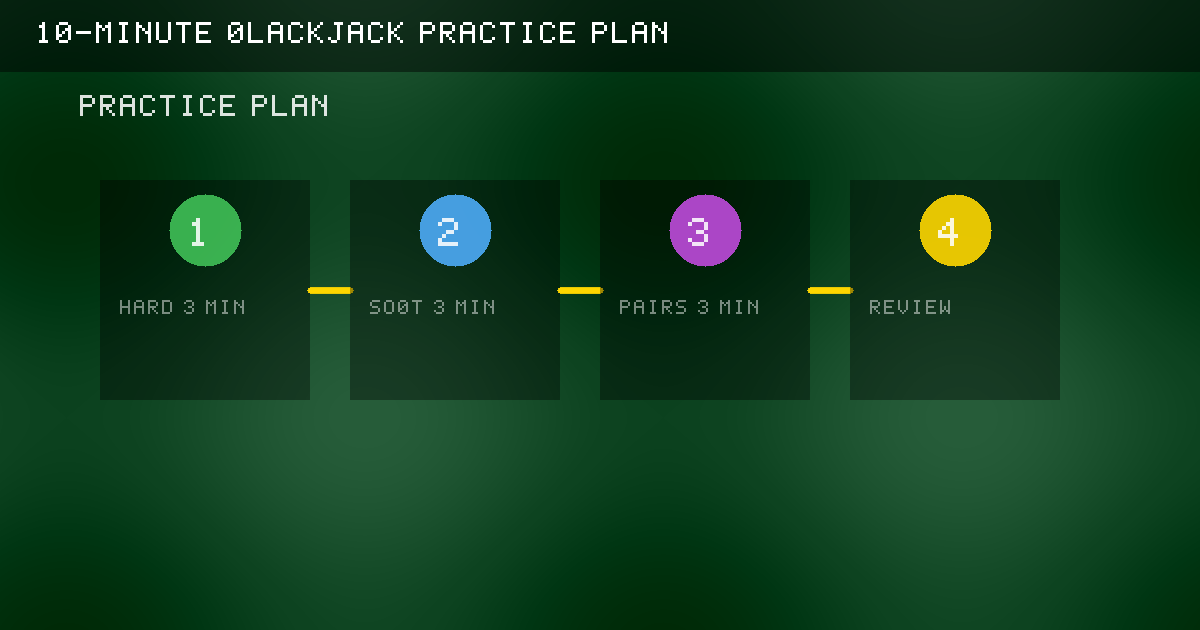
The goal is not to win simulated hands. The goal is to make the correct first decision quickly and consistently. Track accuracy by category: hard totals, soft hands, and pairs. Once a category reaches the target, mix it into full random practice.
The 10-Minute Session
Minute 0–1: Choose one focus
Pick Hard, Soft, or Pairs. Do not start with “All hands” unless you are reviewing. Narrow practice creates faster pattern recognition.
Minute 1–6: Fast decisions
Play without opening the chart. If you are unsure, make the best decision and let the feedback teach you. Hesitation is useful data: it shows which patterns are not automatic yet.
Minute 6–8: Review mistakes
Open hand history and write down the category of each miss: stiff hand, soft double, soft 18, pair rule, or hard double. Do not only write the final action.
Minute 8–10: Correction round
Stay in the same practice focus and play another short burst. Your target is to avoid repeating the exact mistake family from the review step.
Accuracy Targets
Use these targets as promotion rules. If you cannot hit the target in a focused drill, stay with that category before moving to all-hands practice.
- Hard totals: 90% accuracy over two separate 10-minute sessions. Hard 12 and hard 16 are the most important checkpoint hands.
- Soft hands: 85% accuracy at first, then 90%. Soft 18 should be reviewed separately because it has hit, stand, and double cases.
- Pairs: 90% accuracy. Aces, 8s, 10s, and 5s should be instant before you worry about the dealer-dependent pairs.
- All hands: 90% accuracy over at least 50 decisions before you consider the chart usable without reference.
Seven-Day Learning Schedule
- Day 1: Hard totals only. Learn the dealer weak-card pattern: stand more often against 2–6.
- Day 2: Hard totals again. Focus on hard 12, hard 15, and hard 16.
- Day 3: Soft hands. Learn when the Ace lets you double safely.
- Day 4: Soft hands again. Make soft 18 the main target.
- Day 5: Pairs. Memorize always split, never split, then dealer-dependent pairs.
- Day 6: All hands. Track which category produces the most misses.
- Day 7: Review the weakest category, then finish with all hands.
If you miss the same family three times in a session, stop random practice and return to that drill. Repetition is only valuable when it corrects the pattern instead of reinforcing the wrong instinct.
When to Use the Chart
Use the chart before and after a drill, not during every hand. During practice, guessing and receiving feedback builds recall. After the drill, the chart helps convert mistakes into rules. This is similar to flashcard learning: retrieval first, correction second, repetition third.
For best results, rotate between the strategy chart, the mistake analyzer, and the trainer. The chart tells you the answer, the analyzer explains the mistake family, and the trainer gives you enough reps to make the answer automatic.
How to Keep the Session Honest
A ten-minute practice plan works only if the session stays narrow. The easiest way to ruin it is to turn every hand into a referendum on whether you are good at blackjack. That creates noise. The better question is smaller: did this hand belong to the category I meant to practice, and did I recognize the pattern quickly enough?
For hard totals, I would not mix in soft hands until hard 12 through hard 16 feel less emotional. Those totals produce the most hesitation because the hand looks fragile no matter what you choose. For soft hands, the key is to keep saying that the Ace can move. For pairs, sort first: always split, never split, or dealer-dependent. That sorting step makes the chart feel less like trivia.
Stop when the misses repeat. If you miss soft 18 twice, the answer is not another thirty random hands. The answer is five minutes of Ace-7 against different upcards. If you miss pair decisions, switch to pairs. The trainer is useful because it lets you choose the shape of your next repetition instead of waiting for a live deck to happen to show it.
A good session ends with one sentence: next time I will practice this. That sentence matters more than a high score. Accuracy is useful, but the target for the next session is what turns practice into learning.
If the session is going well, resist the urge to extend it forever. Short, clean practice is easier to repeat tomorrow. The point of this plan is not to exhaust the chart in one sitting; it is to make one small family of hands easier than it was when you opened the page.