Blackjack Glossary
Blackjack has its own vocabulary, and the terms come up constantly in strategy discussions and on the felt. This glossary defines the words you'll encounter most often, both at the table and across this site, in plain language.
- Basic strategy
- The mathematically optimal action for every hand against every dealer upcard, derived from computer simulation. Playing perfect basic strategy reduces the house edge to roughly 0.5% in a standard game.
- Bust
- Going over 21. A busted hand loses immediately. Because players act before the dealer, a player who busts loses even if the dealer later busts too.
- Double down
- Doubling your original bet in exchange for exactly one more card, after which your turn ends. Used when you have an advantage, such as an 11 against a weak dealer card.
- Hard hand
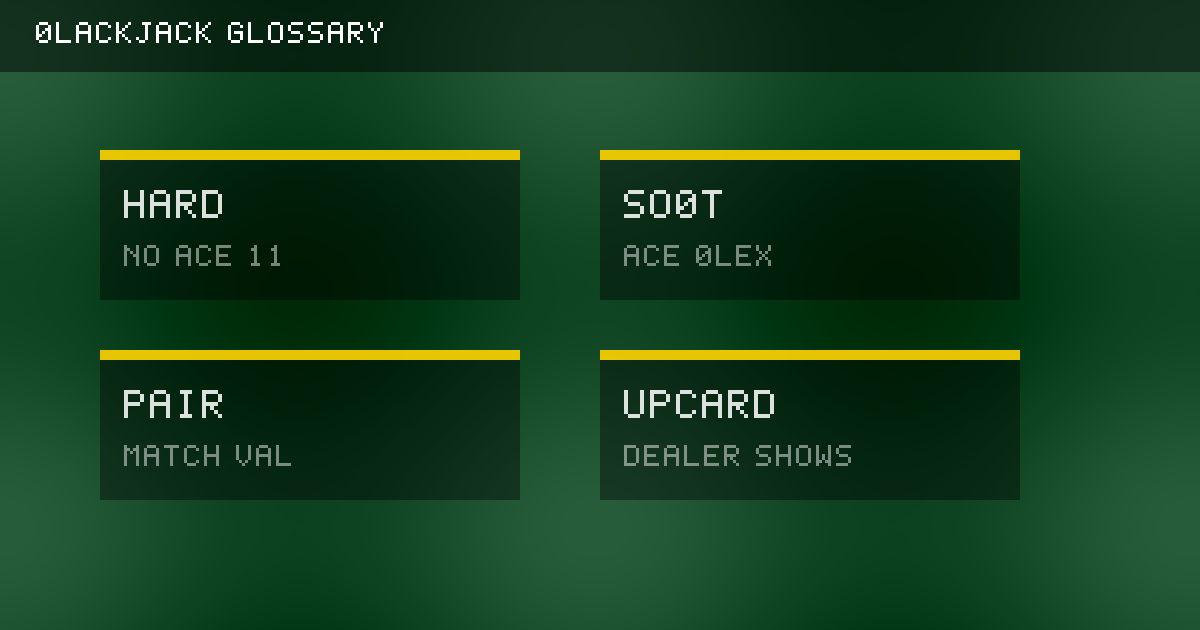
- A hand with no Ace, or one in which the Ace must count as 1 to avoid busting. A hard hand has no flexibility — hitting it can cause a bust.
- Hit
- Taking another card. You may hit as many times as you like until you stand or bust.
- Hole card
- The dealer's face-down card. It's revealed only after all players have finished acting.
- House edge
- The rules' long-run mathematical advantage over a player, expressed as a percentage of each bet. For a basic-strategy player under a standard learning rule set it is often cited around 0.5%; for a guessing player it can be 2–5% or more.
- Insurance
- A side bet offered when the dealer shows an Ace, wagering that the dealer has blackjack. It pays 2:1 but carries a house edge near 7%, so basic strategy always declines it.
- Natural / Blackjack
- An Ace plus a 10-value card as your first two cards — an automatic 21 that beats any other 21 and typically pays 3:2.
- Push
- A tie between the player and dealer. No money changes hands; your original bet is returned.
- Shoe
- The dealing box that holds multiple decks of cards. Many modern blackjack rule references assume a four-, six-, or eight-deck shoe.
- Soft hand
- A hand containing an Ace counted as 11 (for example, Ace-6 is a soft 17). It cannot bust on a single card, because the Ace can drop to 1.
- Split
- Separating a pair into two independent hands, each with its own bet. You always split Aces and 8s; you never split 10s or 5s.
- Stand
- Keeping your current total and ending your turn without taking more cards.
- Stiff hand
- A hard total of 12 through 16 — strong enough to bust if hit, weak enough to lose if stood. These are the hardest hands to play and the source of most close decisions.
- Surrender
- Forfeiting half your bet to end the hand early. "Late surrender," the common form, is allowed only after the dealer checks for blackjack.
- Upcard
- The dealer's face-up card. It's the single most important piece of information for choosing your action, since basic strategy keys every decision off it.
Keep Learning
Full Strategy Guide
Rules, the four decisions, and a complete FAQ in one place.
Soft Hands
Playing an Ace as 11, soft doubling, and the soft-18 problem.
Splitting Pairs
When to split, when to resist, and why Aces and 8s are always split.
Common Mistakes
The instinctive plays that quietly hand the house its edge.
How to Use the Glossary While Practicing
A glossary is most useful when it answers a question at the moment the question appears. If the trainer says soft 17 and you only remember that an Ace is involved, check the term and then return to the hand. Do not try to memorize every definition before practicing. The words become easier once they are attached to actual decisions.
Several terms are easy to confuse at first. A hard hand can contain an Ace if that Ace must count as 1. A soft hand is soft only while the Ace can safely count as 11. A pair is not just two cards that look similar; for strategy purposes, it is two starting cards with the same blackjack value. These distinctions matter because the trainer checks pairs before it checks hard or soft totals.
Use the glossary as a small reset button. When a phrase starts to feel fuzzy, stop for one definition, then play three hands that use the idea. That is enough repetition to make the word practical. Definitions are not the point by themselves. They are handles for recognizing the next hand faster.
If you are teaching someone else, keep the vocabulary plain. Say dealer upcard, hard total, soft total, pair, hit, stand, double, split. Those few words carry most beginner decisions.
The glossary also makes the trainer easier to audit. When a feedback message says "soft" or "pair," it is using these terms in a specific order. Pairs are checked first because splitting can be the right first decision even when the same two cards also form a hard or soft total. That little detail explains why a pair page, a soft-hand page, and the strategy chart can all talk about the same cards from different angles.