Blackjack Rule Variations
Basic strategy is not one universal chart. It depends on the rules of the table. The trainer uses a common beginner baseline — multi-deck blackjack, dealer stands on soft 17, doubling allowed on any first two cards, and re-splitting allowed — because that teaches the patterns most players need first. This page explains how the most important rule variations change the game.
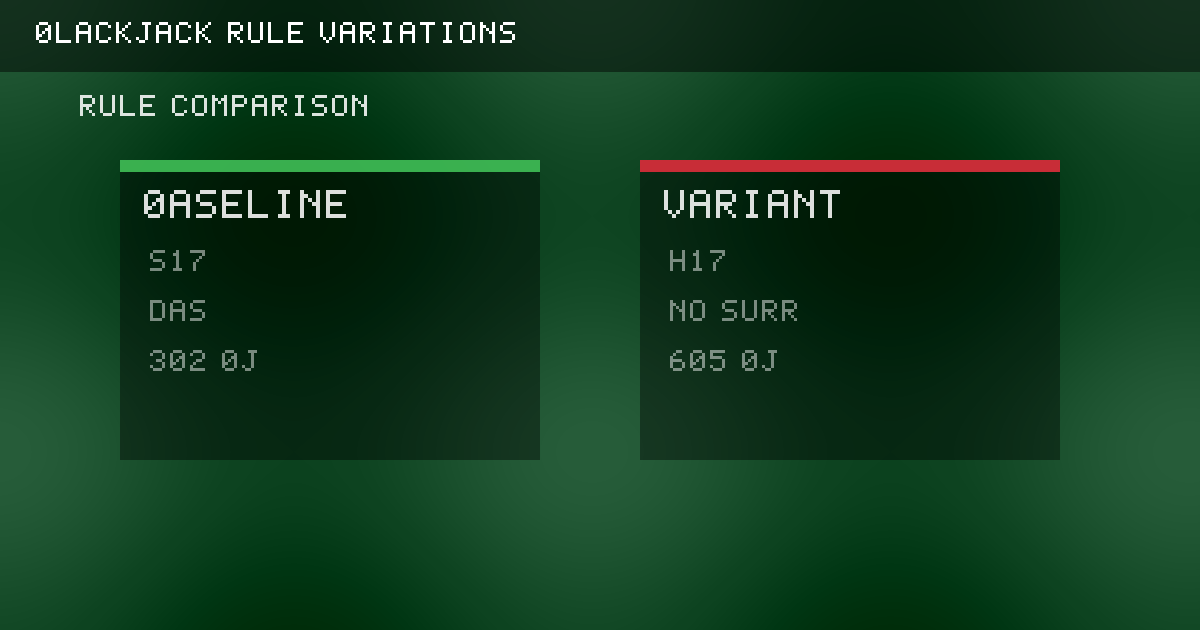
If you only remember one rule-selection principle, remember this: rules that pay you more, let you stop bad hands earlier, or give you more doubling/splitting flexibility help the player. Rules that reduce blackjack payouts or force the dealer to draw more often help the house.
Common Rule Variations
S17: Dealer stands on soft 17
This is better for the player. When the dealer has Ace-6, they stop at soft 17 instead of drawing. The trainer assumes S17 because it is a clean baseline for learning and appears on many strategy references.
H17: Dealer hits soft 17
This is worse for the player. The dealer gets another chance to improve soft 17 into 18, 19, 20, or 21. H17 changes a few close strategy decisions, especially some doubles and surrender spots.
Late surrender
Late surrender lets you give up half your bet after the dealer checks for blackjack. It is useful on a few very bad hands, commonly hard 16 against dealer 9, 10, or Ace and hard 15 against dealer 10 in many rule sets.
Double after split (DAS)
DAS lets you double after splitting a pair. This makes several splits more attractive because each new hand can still be pressed when it catches a good draw.
Re-splitting Aces
Being allowed to split Aces again is favorable because Aces are the strongest starting card. Some casinos restrict this, and many allow only one draw card to each split Ace.
3:2 vs 6:5 blackjack payout
This is one of the biggest table-selection issues. A 3:2 blackjack payout is standard and much better for the player. A 6:5 payout significantly increases the house edge and should generally be avoided.
Deck Count
Single-deck, double-deck, and six- or eight-deck games have slightly different strategy charts because card removal matters more when fewer decks are in play. In general, fewer decks are better for the player when the other rules are equal, but casinos often offset that advantage with worse payout or doubling restrictions.
The trainer uses six decks because it reflects many modern blackjack games and keeps the practice chart broadly useful. A single-deck chart has small differences, but the core ideas remain the same: stand more often when the dealer is weak, hit more often when the dealer is strong, split Aces and 8s, and avoid insurance unless you are counting cards.
How Rules Change Strategy
Most rule variations do not rewrite the entire chart. They change marginal hands: close doubles, surrender decisions, and a few pair splits. For example, H17 makes the dealer stronger, so some Ace-facing decisions become more defensive. Surrender adds a fifth option for the worst starting hands. DAS makes pair splitting better because the resulting hands have more ways to turn favorable.
That is why the trainer starts with the four core actions: hit, stand, double, and split. Once those are reliable, rule-specific adjustments become easier. You are not memorizing a new game from scratch; you are adjusting a small number of border cases around a stable foundation.
- If blackjack pays 6:5: find another table if possible.
- If surrender is available: learn the few surrender hands after you know the core chart.
- If dealer hits soft 17: expect a slightly higher house edge and some changed Ace-related decisions.
- If DAS is allowed: pair splitting becomes more valuable in several spots.
How to Study Rules Without Chasing Every Exception
Rule variations can become a distraction for beginners. It is tempting to ask about every possible rule before the basic hand families are clear. The better order is to learn the common baseline first, then learn which rules move the edges of that baseline. Most changes do not rewrite the whole chart. They change close doubles, a few surrender decisions, and some split decisions.
The trainer uses a fixed baseline because deliberate practice needs a fixed target. If the target changes every hand, a beginner cannot tell whether a wrong answer came from the hand pattern or from a rule assumption. Once the baseline is familiar, rule differences become easier to understand because you can compare them to something stable.
When you read about a rule variation, ask two questions. First, does this rule change the available actions? Surrender, doubling restrictions, and split restrictions do. Second, does it change the dealer's expected strength? Hitting soft 17 does. Those two questions explain most of the practical differences without turning the subject into a rule catalog.
For this site, rule pages are educational context. They are here to explain why a chart has assumptions and why the trainer names its assumptions plainly. The main practice skill is still recognizing the hand in front of you.