Common Blackjack Mistakes
Most of the house edge that casual players give away doesn't come from bad luck — it comes from a small set of instinctive errors repeated hand after hand. Each one feels reasonable in the moment, which is exactly why it persists. Here are the ten mistakes that create the most practice damage, and the basic-strategy correction for each.
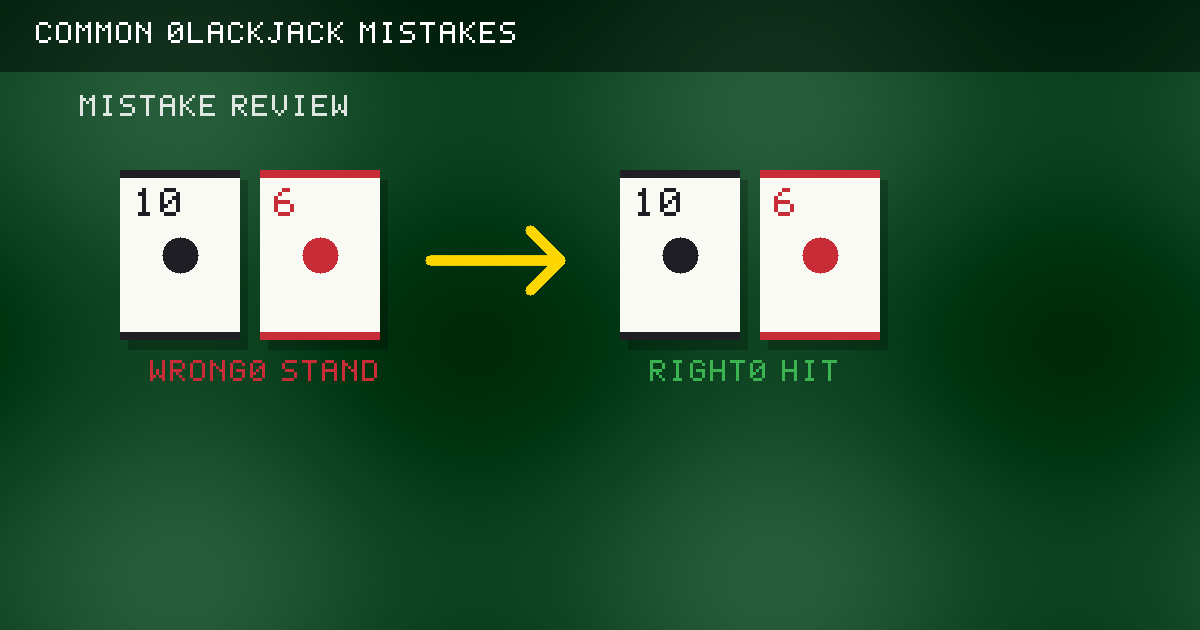
1. Standing on 16 against a high card
A hard 16 feels too risky to hit — one big card and you bust. But against a dealer showing 7 through Ace, standing is even worse: the dealer will usually make 17 or better and beat your 16 anyway. You hit not because 16 is good, but because passively standing loses more often. The hand is bad either way; hitting simply loses less.
2. Not hitting a soft 17
Players see "17" and stand, forgetting the Ace makes it a soft hand that can't bust on the next card. A soft 17 (Ace-6) should always be hit and often doubled against a weak dealer. Standing on it throws away free improvement. Our soft hands guide covers the full pattern.
3. Mimicking the dealer
A surprising number of players adopt the dealer's rule for themselves: always hit until 17, then stop. But the dealer wins ties on busts because players act first — if you both bust, you lose before the dealer even draws. Copying the dealer's fixed rule ignores your single biggest advantage: the freedom to vary your play based on the upcard.
4. Always taking insurance
Insurance feels like protection when the dealer shows an Ace, but it's a separate bet with a house edge near 7%. Decline it every time. The same goes for "even money" on your blackjack. The full reasoning is in our insurance and surrender guide.
5. Splitting 10s
Two 10-value cards make a 20 — a near-certain winner. Splitting them to chase two hands is a classic case of greed beating math: you break up an excellent hand hoping to build two that, on average, end up weaker. Keep the 20 and stand.
6. Not splitting Aces or 8s
The mirror-image error. Two Aces left together make a weak soft 12, and 8-8 is the worst hard total in the game. Both should always be split, regardless of the dealer's card. Failing to split them passes up the game's clearest improvement opportunities — see the splitting pairs guide for why.
7. Failing to double down
Doubling means putting more money out, which makes cautious players hesitate. But the spots where basic strategy says to double — 11 against almost anything, 10 against 2 through 9, soft hands against a weak dealer — are precisely the spots where you have the advantage. Skipping a correct double is leaving guaranteed long-term value on the table out of timidity.
8. Chasing losses with bigger bets
After a rough stretch, the urge to change the size of the next decision is a warning sign, not a strategy. Each hand is independent; previous misses do not make the next hand friendlier. Betting systems are outside this trainer's scope, and they do not change the underlying math. For practice, the useful response to a bad stretch is to stop, name the missed hand family, and drill that family later.
9. Playing at a bad table
Not all blackjack is equal. A table that pays 6:5 on blackjack instead of the traditional 3:2 roughly triples the house edge before the first decision is even made. Tables where the dealer hits soft 17, or that forbid doubling and re-splitting, are also worse. Reading the table rules before sitting down is a "decision" you make before the cards are dealt — see our decks and table rules guide.
10. Believing in streaks and "due" cards
Cards have no memory. A dealer who has won five hands in a row is no more or less likely to win the sixth, and a player who's "due" for a win is a comforting fiction. Basic strategy is built on the long-run probabilities of each situation, and those probabilities don't bend to recent results. Trusting the math over the gut feeling is the entire point.
Every mistake on this list is corrected by the same habit: play basic strategy on every hand, every time, regardless of how the last few hands went. The trainer is built to make that habit automatic through repetition and instant feedback.
Keep Learning
Soft Hands
Playing an Ace as 11, soft doubling, and the soft-18 problem.
Splitting Pairs
When to split, when to resist, and why Aces and 8s are always split.
Insurance & Surrender
Why insurance is a trap and how late surrender saves money.
Blackjack Glossary
Plain-language definitions for every term used at the table.