Trainer Methodology
This page documents the assumptions behind Blackjack Trainer so visitors can understand exactly what the tool teaches and what it does not. The trainer is an educational basic-strategy practice tool. It does not offer gambling, wagers, prizes, accounts, deposits, or operator recommendations.
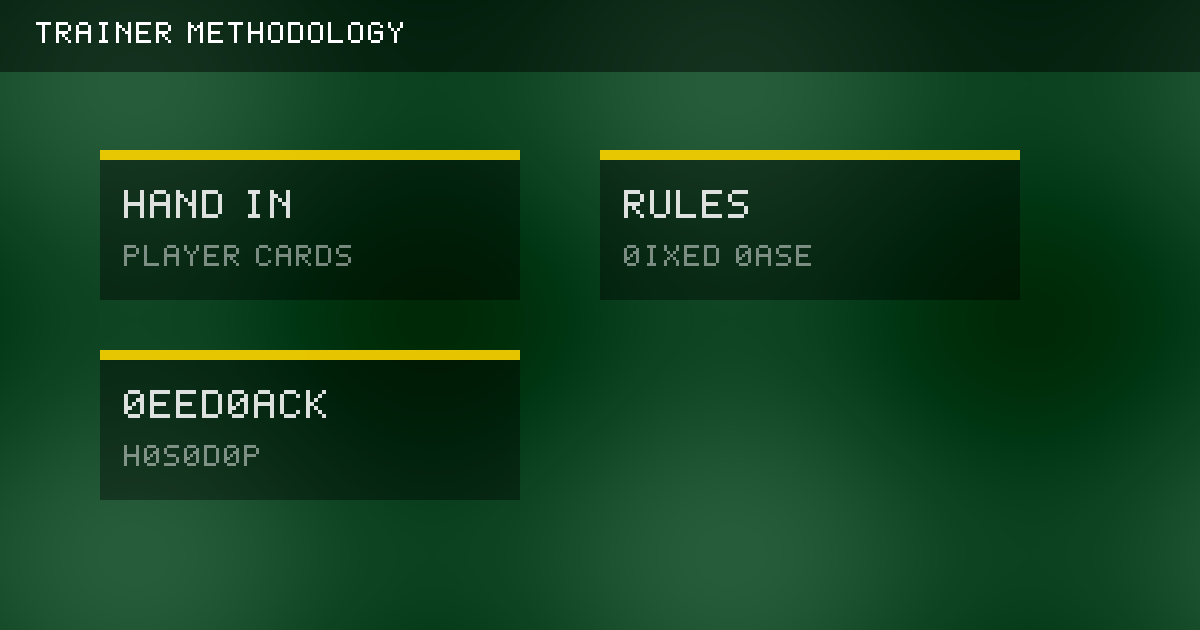
The purpose is narrow: help a learner practice the first decision on blackjack hands using a common multi-deck basic-strategy chart. That means the tool is useful for pattern recognition, but it is not a complete simulation of every casino rule set or every multi-hand outcome after splitting.
Rule Assumptions
- Decks: six-deck shoe for simulated dealing and multi-deck basic strategy.
- Dealer soft 17: dealer stands on soft 17. The strategy chart and the dealer-play animation now use the same S17 baseline.
- Doubling: double down is assumed available on any first two cards. If a chart decision says double but doubling is no longer available after a hit, the trainer uses the standard fallback action.
- Splitting: pair-splitting decisions are taught as first decisions. When the correct play is split, the trainer acknowledges the correct split and starts a fresh hand rather than playing out multiple simultaneous hands.
- Surrender: surrender is explained in the guide content but is not currently one of the trainer's four action buttons.
- Insurance: insurance is not offered in the trainer because it is generally not part of basic-strategy decision practice for non-card-counting players.
How Strategy Feedback Is Generated
For each hand, the trainer evaluates the player's cards, the dealer upcard, whether the hand is soft, and whether the starting cards form a pair. Pairs are checked before hard or soft totals because splitting can be the correct first decision even when the same cards also form a hard or soft total. If the pair chart does not call for a split, the hand falls through to the appropriate soft or hard chart.
The feedback text is generated from the same chart decision. Instead of only saying “correct” or “incorrect,” the trainer names the hand type, names the dealer upcard, gives the correct action, and explains the strategic reason: dealer bust risk, soft-hand flexibility, double-down equity, or pair-splitting value.
This approach is intentionally educational. A player who repeatedly misses hard 16 against dealer 10 needs more than the answer “hit.” They need to recognize the underlying family: stiff hand against a strong dealer upcard. The trainer's feedback and the mistake analyzer are built around that pattern-level learning.
Practice Modes
The practice focus buttons filter the types of starting hands the trainer deals. Hard totals, soft hands, and pairs can be drilled separately. This is not meant to imitate a real shoe distribution; it is meant to create deliberate practice. A real blackjack session might not give you enough soft 18s or pair decisions to learn quickly. A trainer should over-sample weak spots.
“All hands” mode is best used after focused drilling. It mixes categories and tests whether the patterns transfer. If accuracy drops, the recommended workflow is to return to the missed category rather than continue random hands.
Known Limits
- The trainer teaches basic strategy, not card counting.
- The trainer does not model betting systems, bankroll management, comps, or casino promotions.
- The trainer does not promise profit. Even perfect basic strategy does not remove the house edge.
- Some real tables use H17, no DAS, limited splitting, no surrender, 6:5 payouts, or other rule changes that require chart adjustments.
- Outcome animations are secondary to first-decision practice; the primary educational value is whether the chosen action matches the chart.
For rule-specific context, see the rule variations guide. For the exact reference table, see the strategy chart.
Why the Tool Is Narrow on Purpose
A trainer can try to simulate everything, or it can teach one thing clearly. This one chooses the second path. The main skill is the first decision: hit, stand, double, or split. That decision appears before the rest of the hand has a chance to become complicated, and it is the decision most learners can improve through repetition.
The tool does not try to make a dramatic round out of every hand. In particular, split hands are acknowledged rather than played out as several separate hands. That is a design choice. Full split play adds a lot of interface complexity, but it does not change the first lesson: knowing when the split is correct. The same logic applies to side rules. They matter, but they are not the foundation.
The feedback also favors explanation over suspense. A missed hard 16 against a dealer 10 is not just wrong; it belongs to a family of stiff totals against strong upcards. A missed Ace-7 belongs to the soft-hand family. A missed pair of 9s belongs to the pair-splitting family. Naming the family is how a learner gets better on the next hand.
That is the promise and the limit of the methodology. It is not a money tool, a prediction tool, or a complete rule engine. It is a focused practice surface for learning basic-strategy patterns.