Blackjack Mistake Analyzer
Most blackjack mistakes are not random. They usually come from a small set of pattern errors: standing on a stiff hand against a strong dealer card, treating a soft hand like a hard hand, splitting pairs because it feels symmetrical, or missing a double-down opportunity when the dealer is weak. This analyzer turns a wrong answer into a practice plan.
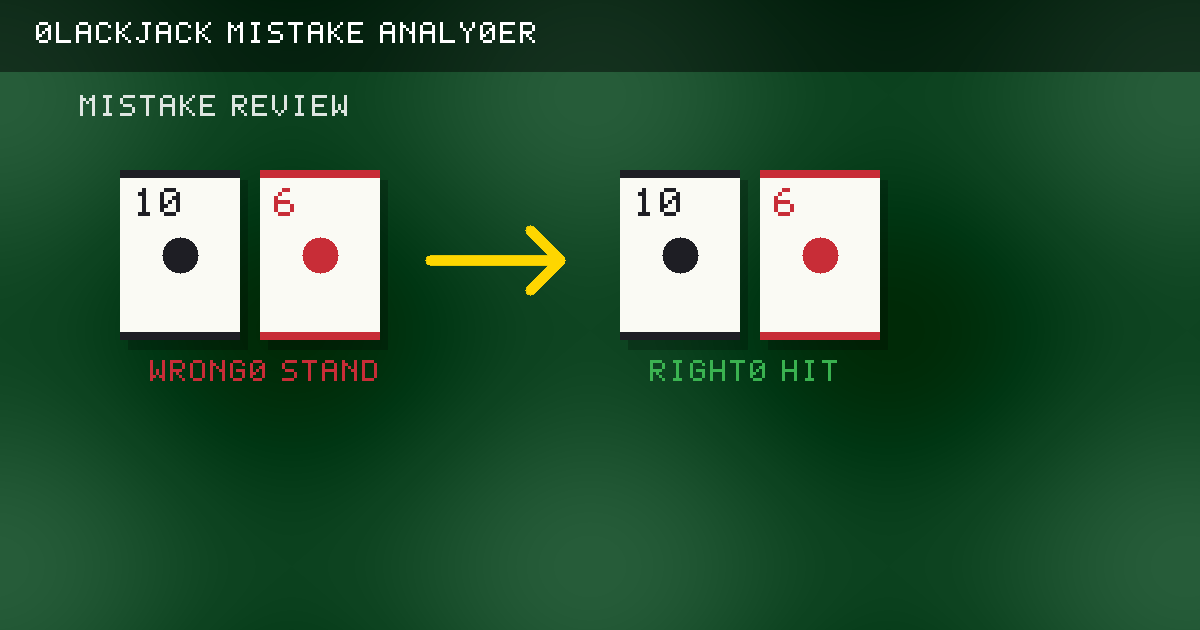
Choose the situation that looks like your missed hand. The analyzer explains the actual basic-strategy logic and points you to the best drill on the trainer.
The important move is to stop treating a miss as a personal failure. A missed hand is usually just evidence that one pattern has not settled yet. If you stood on hard 16 against a dealer 10, the problem is not that you forgot one square. The problem is that stiff hands against strong upcards still feel worse to hit than they actually are. Naming that pattern makes the next practice session obvious.
Use the analyzer right after a short drill, while the hand still has a little emotional charge. That is when the explanation is easiest to remember. If you wait until later, every miss turns into the same vague memory: "I knew I got something wrong." The useful version is sharper: hard total, dealer upcard, action chosen, better action, and the reason.
The Five Mistake Families
1. Stiff-hand mistakes
A stiff hand is usually hard 12 through hard 16: high enough to bust if you draw a 10-value card, but low enough that standing often loses. The dealer upcard decides the play. Against 2 through 6, the dealer busts often enough that standing can be right. Against 7 through Ace, the dealer is more likely to finish with 17 or better, so standing on 13–16 simply loses too often.
2. Soft-hand mistakes
Soft hands are often underplayed because they look stronger than they are. An Ace gives flexibility, not a guarantee. Soft 18 is the classic example: it stands against 7 and 8, doubles against weak dealer cards when allowed, and hits against 9, 10, or Ace. If you always stand on soft 18, you are using comfort instead of expected value.
3. Pair mistakes
Pairs tempt players to split because two equal cards look like a special event. Basic strategy is more selective. Aces and 8s are always split. 10s are never split because 20 is already excellent. 5s are never split because they form hard 10, a strong double-down hand. The other pairs depend on whether the dealer is weak enough to justify creating two hands.
4. Double-down mistakes
Doubling is where blackjack rewards precision. Hard 10 and 11 frequently double because one more card is likely to create a strong total. Soft doubles use the Ace's flexibility to press an advantage against dealer 4, 5, or 6. Missing doubles does not look dramatic in a single hand, but it quietly gives up value over hundreds of decisions.
5. Side-bet and rule mistakes
Insurance feels protective, but for a basic-strategy player it is usually a negative-expectation side bet. Surrender can be good when available, but only in specific high-risk spots such as hard 16 against a dealer 9, 10, or Ace in many rule sets. The trainer focuses on core decisions first because side rules vary by table.
These families also keep practice calm. Instead of trying to repair everything at once, you can pick one family and run a short focused drill. Hard-total mistakes get hard-total practice. Soft-hand mistakes get soft-hand practice. Pair mistakes get pair practice. That sounds almost too simple, but it prevents the most common wasteful loop: random hands after a specific miss.
How to Use This After a Missed Hand
- Name the family. Was the error about a stiff hand, a soft hand, a pair, a double, or a side rule?
- Check the dealer upcard. Most mistakes happen because the player ignores whether the dealer is weak, medium, or strong.
- Practice the narrow drill. Use the trainer's practice focus to drill hard totals, soft hands, or pairs instead of playing random hands.
- Review the strategy chart. Confirm the exact square, then return to the trainer and play until the pattern feels automatic.