Splitting Pairs in Blackjack
Splitting is the only decision in blackjack that turns one hand into two — and one bet into two. Done right, it lets you put more money down when you're in a strong position and escape from the game's worst hand. Done wrong, it doubles your exposure on losing situations. This guide breaks pair splitting into three groups: the pairs you always split, the pairs you never split, and the pairs whose answer depends on the dealer.
What Splitting Actually Does
When your first two cards are a pair — two cards of the same rank — you may separate them into two independent hands, each receiving a second card and each carrying a wager equal to your original bet. You then play each hand in turn. Because splitting commits a second bet, the question is never just "can I split?" but "does turning this into two hands improve my expected outcome enough to justify the extra money?"
You split for one of two reasons: to escape a bad total by breaking it into two more promising starting hands, or to press your advantage by getting more money onto the table when the dealer is weak. Aces and 8s are the textbook example of the first; low pairs against a bustable dealer are the second.
Always Split: Aces and 8s
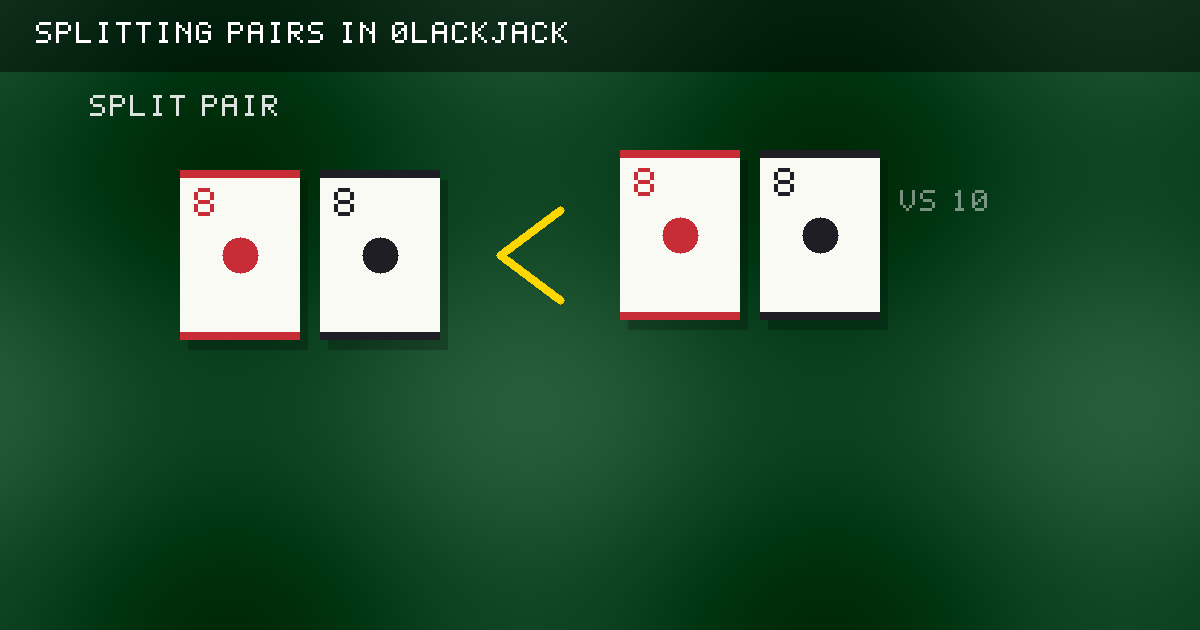
Two pairs should be split against every dealer upcard, no exceptions. Aces are split because a single hand of two Aces is a soft 12 — a weak, awkward total — while two hands each starting with an Ace are two of the strongest possible starting positions, each one card away from 21. Most casinos restrict split Aces to one card each, and you still split them every time; the upside is that large.
Eights are split because 8-8 is a hard 16, the single worst hand in blackjack. A 16 wins rarely and busts often if you hit it. Splitting the pair throws away that hopeless 16 and replaces it with two hands each starting on 8, which can grow into 18s, 19s, and 20s. Even against a dealer's 9, 10, or Ace — where you'll often lose one or both hands — splitting 8s loses less money on average than standing on 16 or hitting into a likely bust.
Never Split: 10s and 5s
A pair of 10-value cards is a 20 — the second-best hand in the game. Splitting it to chase two separate 20s is greedy and wrong: you'd be breaking up a near-certain winner in the hope of building two hands that, on average, end up weaker than the 20 you started with. Always keep the 20 and stand.
A pair of 5s is a hard 10, and a hard 10 is a doubling hand, not a splitting hand. Splitting fives gives you two hands each starting on 5 — two weak beginnings — when you could instead treat the 10 as one strong total and double down against a dealer 2 through 9. Never split 5s; think of the hand as a 10 instead.
It Depends on the Dealer: Everything Else
The remaining pairs are split only when the dealer's upcard is weak enough to make two aggressive hands worthwhile. The pattern below assumes a standard multi-deck game where doubling after a split is allowed.
- 2s and 3s: Split against dealer 2 through 7. Otherwise hit.
- 4s: Split only against dealer 5 and 6 (and only with double-after-split allowed). Otherwise hit — 4-4 is a fine hard 8.
- 6s: Split against dealer 2 through 6. Otherwise hit.
- 7s: Split against dealer 2 through 7. Otherwise hit.
- 9s: Split against dealer 2 through 6 and against 8 and 9. Stand against 7, 10, and Ace — against a 7 your 18 likely beats the dealer's probable 17, and against 10 or Ace you keep the made 18.
Splitting 9s against a dealer 7 feels right because 7 looks beatable — but you already have an 18, which beats the dealer's most likely outcome of 17. The "hole" in the splitting range (stand on 7, then split again on 8 and 9) is one of the most missed patterns in basic strategy.
How Doubling-After-Split Rules Change Things
Whether the casino lets you double after splitting (often abbreviated DAS) shifts several of these decisions. When double-after-split is allowed, splitting becomes more attractive because each new hand can itself be doubled if it lands on a strong total — so you split low pairs like 2s, 3s, and 4s slightly more often. When doubling after a split is forbidden, those marginal splits become hits instead. The trainer and chart on this site assume DAS is permitted, which is the most common rule in multi-deck games.
Drill the Pairs
Pair decisions have the most moving parts of any hand type, which makes them the ideal thing to isolate. Use the "Pairs" practice focus in the trainer to deal nothing but pairs, and watch how the correct answer flips as the dealer upcard changes. The always/never pairs lock in quickly; the upcard-dependent ones are where focused repetition pays off.
Keep Learning
Soft Hands
Playing an Ace as 11, soft doubling, and the soft-18 problem.
Insurance & Surrender
Why insurance is a trap and how late surrender saves money.
Common Mistakes
The instinctive plays that quietly hand the house its edge.
Blackjack Glossary
Plain-language definitions for every term used at the table.