Soft Hands in Blackjack
Soft hands are the part of basic strategy that trips up the most players. They follow different rules from hard totals, they create the game's most profitable doubling opportunities, and they're the reason a hand like Ace-6 should almost never be left to stand. This guide explains what a soft hand is, why it's played the way it is, and the exact decisions for every soft total.
What Makes a Hand "Soft"
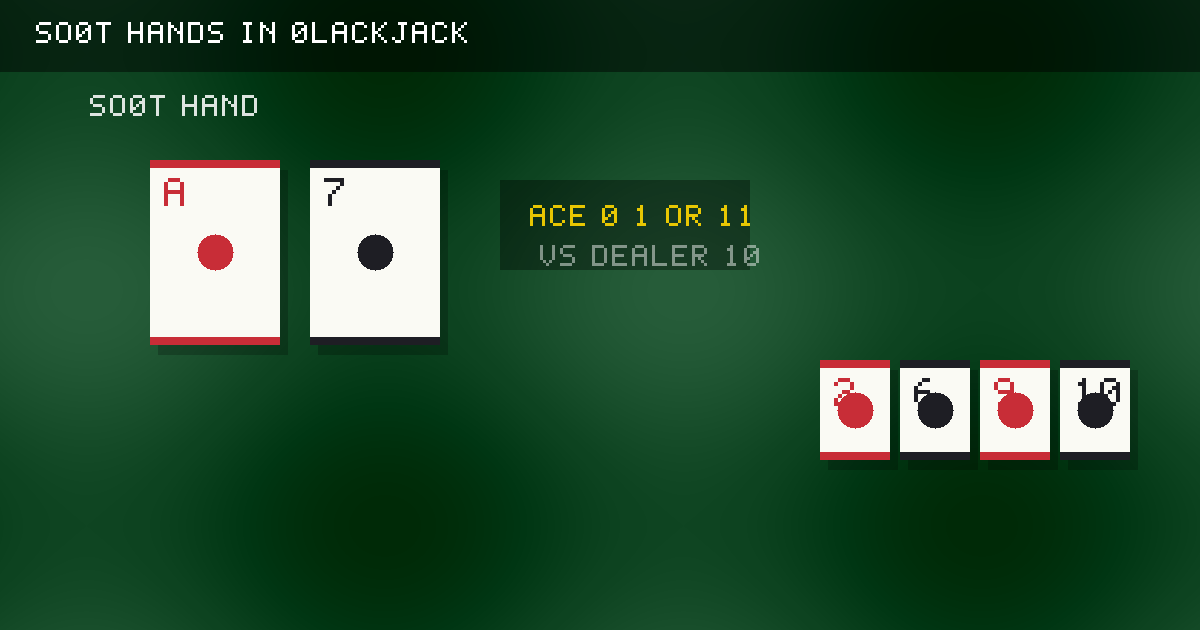
A soft hand is any hand that contains an Ace being counted as 11. The Ace is the only card in blackjack with two values — it can be worth 1 or 11 — and a hand uses the 11 value whenever doing so doesn't bust. Ace-6, for example, is a soft 17: it could be read as 7 or as 17, and basic strategy always reads it as the higher, safer total until a card forces the Ace down to 1.
The word "soft" describes the safety net. Because the Ace can quietly drop from 11 to 1, you cannot bust a soft hand by taking a single card. Hit a soft 17 and catch a 9, and you don't go to 26 and lose — the Ace becomes a 1 and you simply have a hard 16. That one-card immunity to busting is the single most important fact about soft hands, and it's the reason they are played far more aggressively than hard totals of the same number.
A hard 17 (like 10-7) is a finished hand — hitting it risks an immediate bust. A soft 17 (Ace-6) is a free roll: you can try to improve it with zero downside on the next card. That asymmetry drives every soft-hand decision.
Soft Totals vs. Hard Totals
Compare the two 17s directly. With a hard 17, standing is correct against every dealer upcard because hitting only invites a bust and your 17 is already a respectable total. With a soft 17, standing is a mistake against most upcards — you should hit it, and against a dealer's weak 3 through 6 you should actually double down. The number on the hand is identical; the correct play is completely different. This is why memorizing "always stand on 17" without distinguishing soft from hard leads players astray.
The general principle: soft hands want to be hit more often and stood on less often than the matching hard total, because every hit carries no bust risk and a real chance to land on a strong number. A soft 13 through soft 17 is a weak total on its own, but it's a launchpad rather than a liability.
When to Stand on a Soft Hand
- Soft 19 and soft 20 (Ace-8, Ace-9): Stand. These are strong made hands; only soft 19 against a dealer 6 is a doubling exception in some rule sets.
- Soft 18 (Ace-7): This is the trickiest hand in the game. Stand against a dealer 2, 7, or 8. Double against 3 through 6 if allowed (otherwise stand). Hit against 9, 10, or Ace — a soft 18 is an underdog against those strong upcards.
- Soft 17 and below: Never stand. There is no upcard against which standing on a soft 17 or lower is the best play.
When to Double a Soft Hand
Soft doubling is where players leave the most money on the table, because the opportunity feels counterintuitive — you're doubling a hand that hasn't even made a strong total yet. But you double soft hands when the dealer is weak (showing a low card likely to bust) and your hand has good improvement potential. You're not betting that your current total wins; you're betting that the combination of a likely dealer bust and your one-card upside is worth twice the money.
- Soft 13–14 (Ace-2, Ace-3): Double against dealer 5 and 6.
- Soft 15–16 (Ace-4, Ace-5): Double against dealer 4, 5, and 6.
- Soft 17 (Ace-6): Double against dealer 3, 4, 5, and 6.
- Soft 18 (Ace-7): Double against dealer 3, 4, 5, and 6 — otherwise stand or hit per the rules above.
When a casino forbids doubling after a split, or you've already taken a third card, you can't double. In that case the fallback is to hit the soft totals you would have doubled (except soft 18, where the fallback is to stand against 3–6). Never let "I can't double" turn into "so I'll just stand" on a low soft hand.
Why Soft 18 Is the Hardest Hand
Ace-7 looks like a good hand — 18 is above the dealer's 17 stand line — so the instinct is to stand on it every time. That instinct costs money. Against a dealer's 9, 10, or Ace, an 18 simply loses too often; those upcards make strong hands frequently enough that you're an underdog, and hitting the soft 18 (which can't bust on one card) gives you a chance to improve to 19, 20, or 21 while still retaining the ability to keep drawing. Standing on soft 18 against a 10 is one of the most common and most expensive mistakes casual players make.
Practice the Pattern
Soft-hand decisions become automatic with repetition far faster than they do through memorization. Use the trainer's "Soft hands" practice focus to drill only hands containing an Ace, and pay close attention to the doubling ranges against dealer 3 through 6. Once the soft-18 exceptions feel natural, you've cleared the hardest hurdle in basic strategy.
Keep Learning
Splitting Pairs
When to split, when to resist, and why Aces and 8s are always split.
Insurance & Surrender
Why insurance is a trap and how late surrender saves money.
Common Mistakes
The instinctive plays that quietly hand the house its edge.
Full Strategy Guide
Rules, the four decisions, and a complete FAQ in one place.