Decks & Table Rules
Two blackjack tables can look identical and offer wildly different odds. The number of decks in the shoe and a handful of posted rules can swing the house edge from a player-friendly 0.3% to a punishing 2% or more — before the first decision is even made. This guide explains the rules that matter, how each one moves the edge, and why the trainer on this site uses the most common multi-deck configuration.
How Many Decks Are in Play
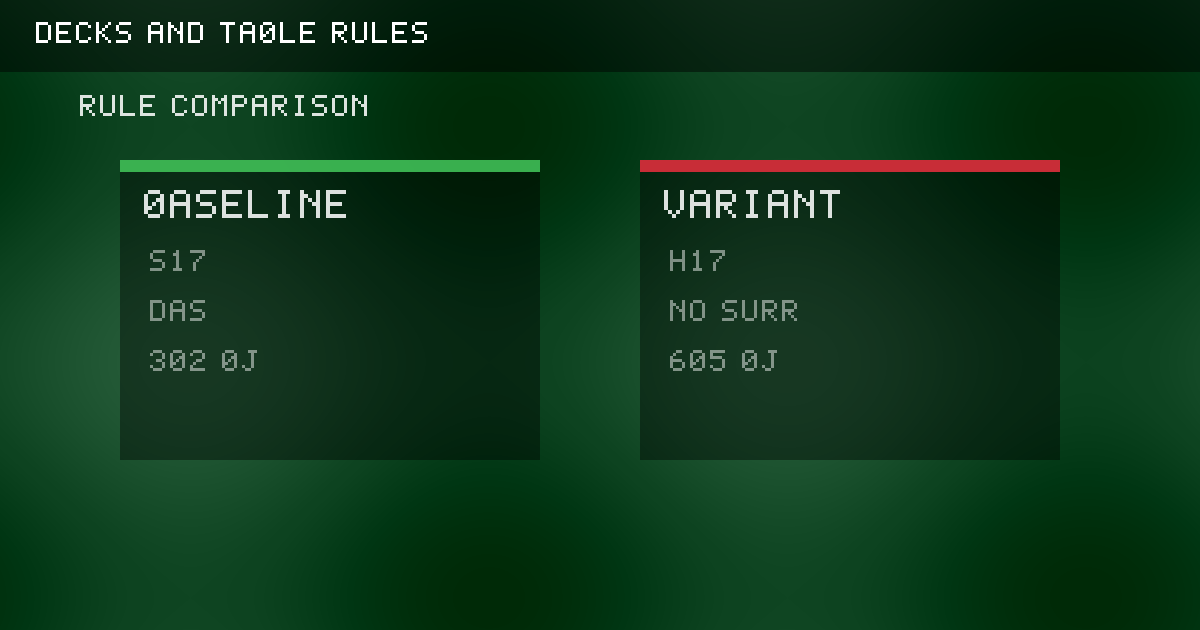
Blackjack is dealt from anywhere between one and eight decks. Single-deck and double-deck games give the player slightly better odds, because removing cards has a larger proportional effect and blackjacks occur a touch more often. As casinos add decks, the house edge creeps up by a small amount. Most casino blackjack today is dealt from a six-deck or eight-deck "shoe," which is why standard basic strategy is built around the multi-deck game.
The strategy chart and hands in this trainer assume a 4–8 deck game. The differences for single- and double-deck games are minor edge cases — a few totals played slightly differently — so multi-deck strategy is the correct foundation to learn first, and it applies to the vast majority of tables you'll actually sit at.
3:2 vs. 6:5 Blackjack Payouts
This is the single most important rule to check, and the one most often overlooked. Traditionally, a natural blackjack pays 3:2 — a $10 bet returns $15. Many tables, especially lower-limit ones, now pay only 6:5, returning just $12 on that same blackjack. That seemingly small change adds roughly 1.4% to the house edge, which is larger than the entire edge a basic-strategy player faces at a good 3:2 table. No amount of perfect play overcomes a 6:5 payout. For study purposes, mark 6:5 as a rule change that makes the game less favorable; it is not a trainer setting.
Dealer Hits or Stands on Soft 17
The felt will say either "dealer stands on all 17s" or "dealer hits soft 17." When the dealer hits soft 17 (often abbreviated H17), they get an extra chance to improve a weak 17 into a stronger hand, which adds about 0.2% to the house edge in the casino's favor. A table where the dealer stands on all 17s is better for you. This rule also changes a few strategy decisions at the margins, particularly some doubling and surrender plays against an Ace.
Doubling and Splitting Restrictions
The freedom to double and split is worth real money, so casinos sometimes restrict it:
- Double on any two cards is best. Some tables only allow doubling on totals of 9, 10, or 11, which removes profitable soft doubles.
- Double after split (DAS) allowed helps the player and makes several low-pair splits correct. Forbidding it nudges those splits back to hits.
- Re-splitting allowed lets you split again if you draw a third matching card, which slightly favors the player.
- Re-splitting Aces is a rare bonus; most casinos restrict split Aces to a single card each.
Surrender Availability
A table that offers late surrender is better for the player, because it provides a damage-control option on the worst hands. Surrender is relatively uncommon and is most often found at higher-limit tables. When it's available, a few hard 15s and 16s against strong dealer upcards are surrendered rather than played out — see the insurance and surrender guide for the exact spots.
Reading a Table Before You Sit
Every rule above is usually printed on the table felt or a small placard. A genuinely good blackjack table reads something like: multi-deck, 3:2 blackjack, dealer stands on all 17s, double on any two cards, double after split allowed, and surrender offered. A table to avoid reads: 6:5 blackjack, dealer hits soft 17, doubling restricted to 10 and 11. Learning to scan these in a few seconds is a skill that saves more money than any in-hand decision.
Choosing a good table is the highest-value decision in blackjack, and it happens before any cards are dealt. Perfect basic strategy at a bad table still loses faster than mediocre play at a good one.
Does Basic Strategy Still Apply?
Yes. The core of basic strategy holds across nearly every standard game — the handful of rule-specific exceptions are small refinements layered on top of the same foundation. Learn the standard multi-deck strategy in the trainer first; it's correct for the games you'll encounter most, and it gives you the base from which the rare variations are easy adjustments.
Keep Learning
Common Mistakes
The instinctive plays that quietly hand the house its edge.
Insurance & Surrender
Why insurance is a trap and how late surrender saves money.
Blackjack Glossary
Plain-language definitions for every term used at the table.
Full Strategy Guide
Rules, the four decisions, and a complete FAQ in one place.